من القلب، لأجل الإنسانية – From the HEART, for Humanity
Cross-Cutting Commitments
Across all programs and operations, HEART integrates core commitments that guide its humanitarian action, including gender equality and inclusion, accountability to affected populations (AAP), and a strong Do No Harm approach. The organization aligns its work with the Sustainable Development Goals (SDGs)—particularly Goals 3 (Health), 4 (Education), 5 (Gender Equality), and 17 (Partnerships)—and applies robust Monitoring, Evaluation, Accountability, and Learning (MEAL) systems to ensure quality, learning, and continuous improvement
من القلب، لأجل الإنسانية – From the HEART, for Humanity
Guided Values
We are guided by the core humanitarian principles of humanity, neutrality, independence and impartiality, HEART ensures that all interventions uphold international humanitarian law and globally recognized standards while promoting dignity, resilience and sustainability.
HEART helps populations that affected by conflict & displacement with particular focus on women and children, elderly persons, people with special needs and disabilities, and other vulnerable groups. In addition, HEART places strong emphasis on supporting Internally Displaced Persons (IDPs), refugees, and host communities in both urban and rural areas across Sudan.
Strengthening humanitarian protection for the most vulnerable, including protecting children and at‑risk groups from violence, exploitation, and neglect.
Enhancing the capacities of local communities and their institutions through vocational training, entrepreneurship, and support for economic recovery.
Where We Work
Geographical coverage
HEART is headquartered in Khartoum with operational offices in Gederaif, Khartoum, Kassala, Alshamaliya, Blue Nile, Sinnar, Darfur states, and South Kordofan.
Since 2022
Our Identity & Purposes
From the Heart , for Humanity
HEART (Humanitarian Empowerment and Relief Team) is a voluntary, independent, non-profit, non-political, and non-religious organization based in Sudan. Founded by experienced professionals, HEART is committed to delivering ethical, sustainable, and locally led humanitarian responses in times of crisis and beyond.
Guided by international humanitarian law and national regulations, HEART works to empower vulnerable communities through integrated interventions in relief, health, education, protection, and livelihoods. Our mission is rooted in dignity, resilience, and inclusive development.
HEART’s visual identity reflects its values: a red heart containing a world map symbolizes global compassion; a glowing candle sheltered inside a humble tent represents hope, learning, and protection in the darkest moments. Together, they embody our commitment to humanity—wherever it is needed most.
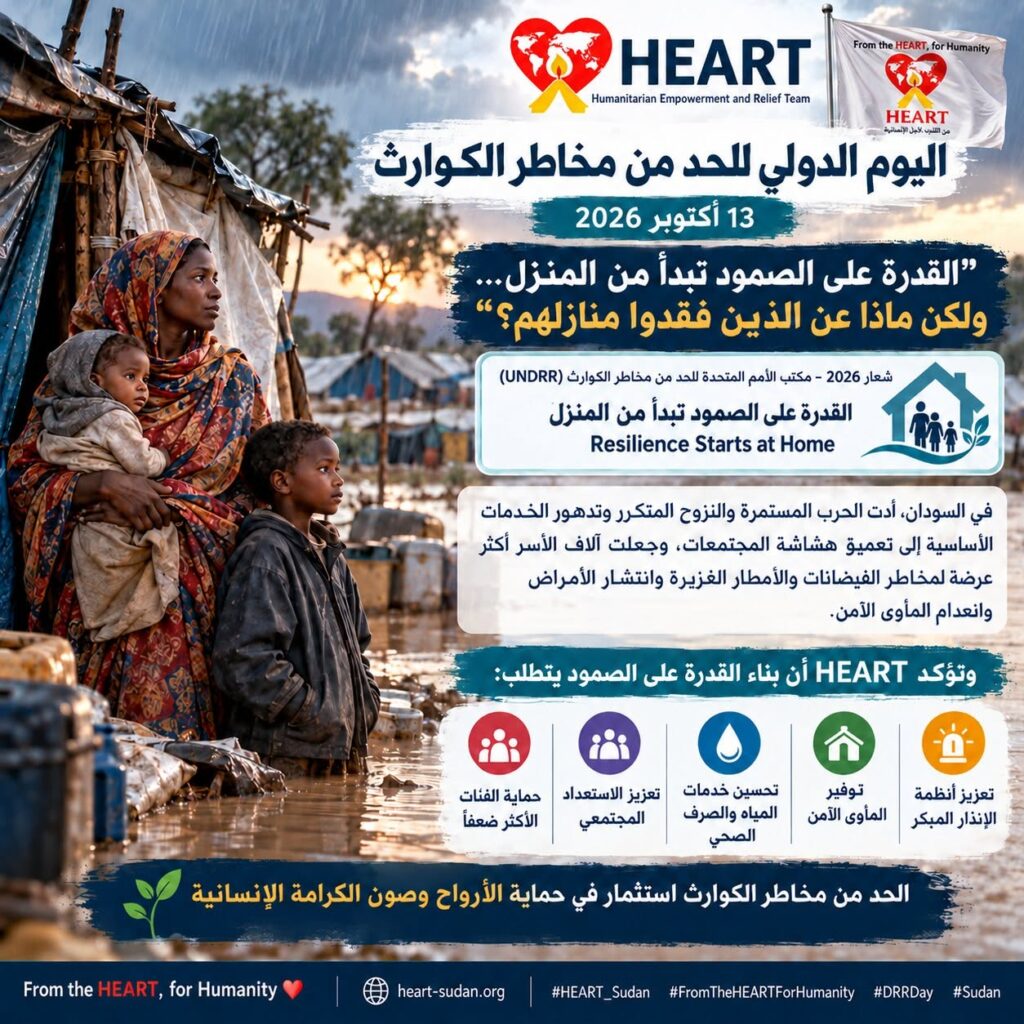
Resilience Starts at Home… But What About Those Who Have Lost Their Homes?
In Sudan, natural disasters are no longer the only threats to people’s lives. The ongoing war, repeated displacement, and deterioration of essential services have deepened community vulnerabilities, leaving thousands of families increasingly exposed to floods, heavy rainfall, disease outbreaks, and the lack of safe shelter.
Families who have lost their homes and been forced to flee, sometimes more than once, face compounded challenges when their new places of residence are struck by natural disasters. This is particularly true in displacement sites that lack adequate infrastructure, water and sanitation services, and protection.
On International Day for Disaster Risk Reduction 2026, observed under the theme promoted by the United Nations Office for Disaster Risk Reduction (UNDRR):
“Resilience Starts at Home.”
HEART – Humanitarian Empowerment and Relief Team – emphasizes that building resilience in Sudan requires a shift from responding to disasters after they occur toward investing in prevention and early preparedness through:
🔹 Strengthening Early Warning Systems: Ensuring that warnings about floods, flash floods, and other hazards reach at-risk communities in a timely manner.
🔹 Providing Safe Shelter: Particularly for displaced families living in temporary settlements or disaster-prone areas.
🔹 Improving Water, Sanitation, and Hygiene Services: Reducing health risks associated with flooding and the contamination of water sources.
🔹 Enhancing Community Preparedness: Raising risk awareness and developing evacuation plans and local response strategies with the active participation of communities themselves.
🔹 Protecting the Most Vulnerable Groups: Particularly children, women, older people, and persons with disabilities, while ensuring that their needs are considered in preparedness and response plans.
❤️ Disaster risk reduction is not merely about preparing for emergencies; it is an investment in protecting lives, preserving human dignity, and building a safer future.
In Sudan, where many people have lost their homes, efforts to build resilience must begin by ensuring every family’s right to safe shelter and a dignified life.
A natural disaster should never become another humanitarian tragedy whose impact could have been reduced.
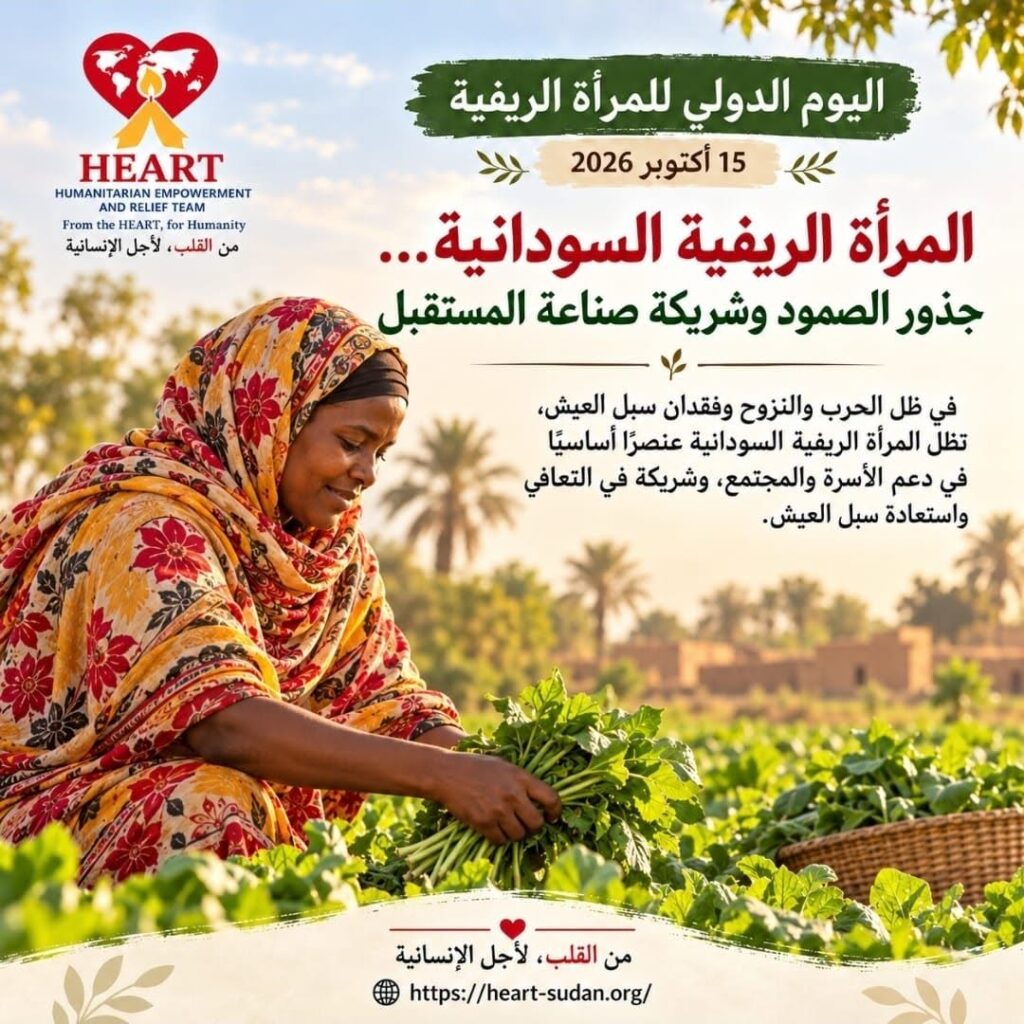
Sudanese Rural Women… The Roots of Resilience and Partners in Shaping the Future
Amid war, displacement, and the loss of livelihoods, Sudanese rural women continue to support their families and communities, despite their growing needs for food, water, healthcare, and protection.
HEART Organization emphasizes that supporting rural women must go beyond immediate humanitarian assistance to include economic and social empowerment, the protection of their rights, and support for their participation in recovery efforts and the rebuilding of livelihoods.
We call for:
🌱 Restoring agricultural activities and sources of income.
💧 Improving access to water, healthcare, and nutrition services.
🤝 Strengthening protection and participation in decision-making.
🌾 Supporting women-led initiatives in agriculture, food security, and livelihoods.
Rural women are not merely beneficiaries; they are partners in developing solutions and building a safer, more stable future.
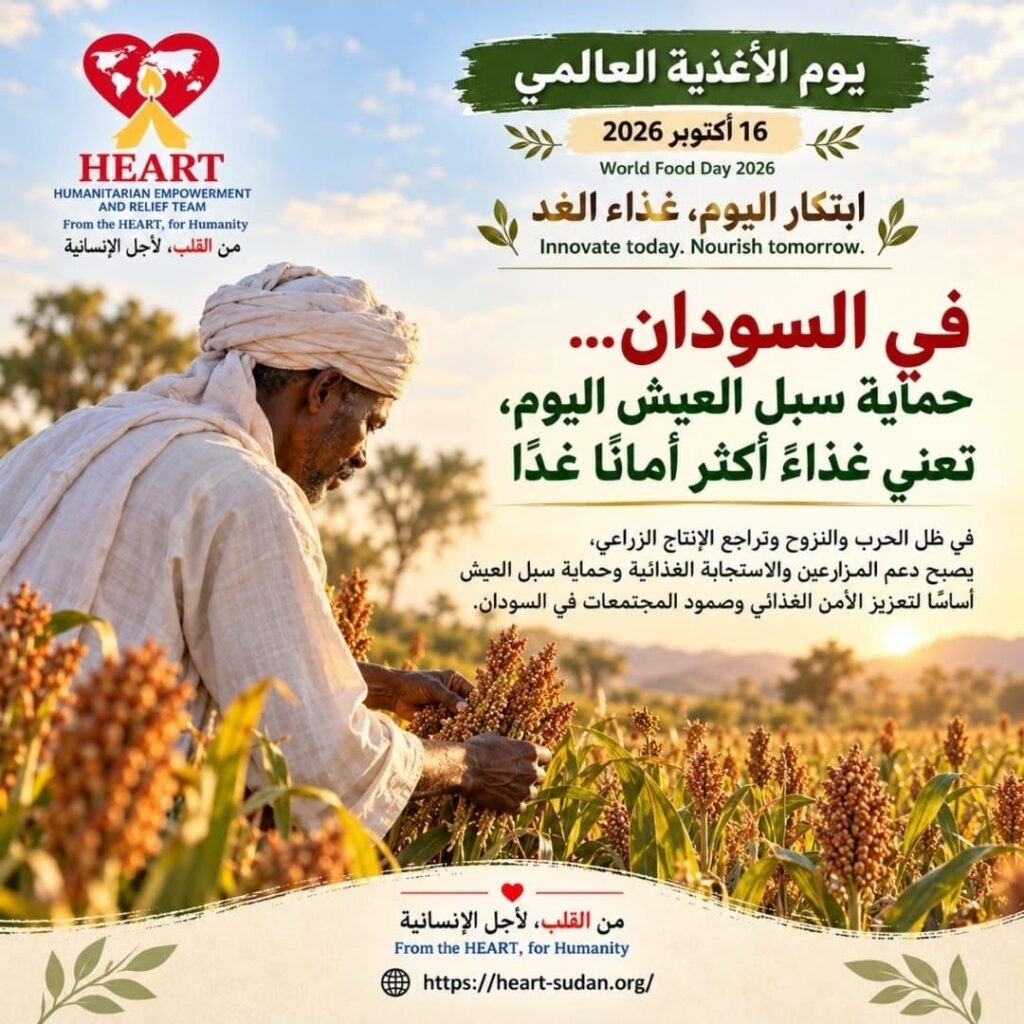
In Sudan, producing food is not enough; we must also ensure that it reaches those who need it most.
In a country renowned for its fertile agricultural lands and rich natural resources, access to sufficient and nutritious food has become a daily challenge for millions of Sudanese families amid the ongoing war, displacement, disruptions to agricultural production, and deteriorating livelihoods.
War does not merely deprive people of food. It also prevents farmers from accessing their land, disrupts markets and supply chains, and forces families to lose their sources of income, increasing their dependence on humanitarian assistance.
According to the Integrated Food Security Phase Classification (IPC) analyses, approximately 19.5 million people in Sudan faced high levels of acute food insecurity between February and May 2026, highlighting the scale of the humanitarian crisis and the urgent need for a sustainable response.
On World Food Day 2026, celebrated under the theme of the Food and Agriculture Organization of the United Nations (FAO):
emphasizes that innovation in addressing hunger in Sudan is not limited to modern technologies. It also includes locally driven solutions that help communities restore their capacity to produce food and access it.
HEART calls for prioritizing the following actions:
🌾 Supporting Local Agricultural Production: Empowering farmers, particularly small-scale producers and rural women, by providing access to seeds, agricultural inputs, and the tools needed to restore food production.
🍲 Strengthening Emergency Food and Nutrition Assistance: Ensuring that life-saving assistance reaches the most vulnerable families, particularly children, pregnant and breastfeeding women, and displaced people.
💧 Improving Access to Water: Recognizing water as an essential resource for agricultural production, health, nutrition, and food security.
🤝 Protecting Livelihoods and Building Resilience: Supporting community-led initiatives and locally appropriate agricultural solutions while linking humanitarian assistance with early recovery opportunities.
🕊️ Ensuring Safe and Unhindered Humanitarian Access: Preventing conflict and displacement from becoming additional barriers that deprive families of food and essential assistance.
Combating hunger is not only about providing food today; it is also about protecting people’s ability to produce their own food tomorrow.
In Sudan, where the consequences of war intersect with poverty, displacement, and declining agricultural production, investing in food security and livelihoods means investing in human dignity, community resilience, and the future of generations to come.
HEART Calls for Integrated Humanitarian and Development Responses as Conflict Deepens Vulnerability and Restricts Humanitarian Access
Khartoum, Sudan | October 2026
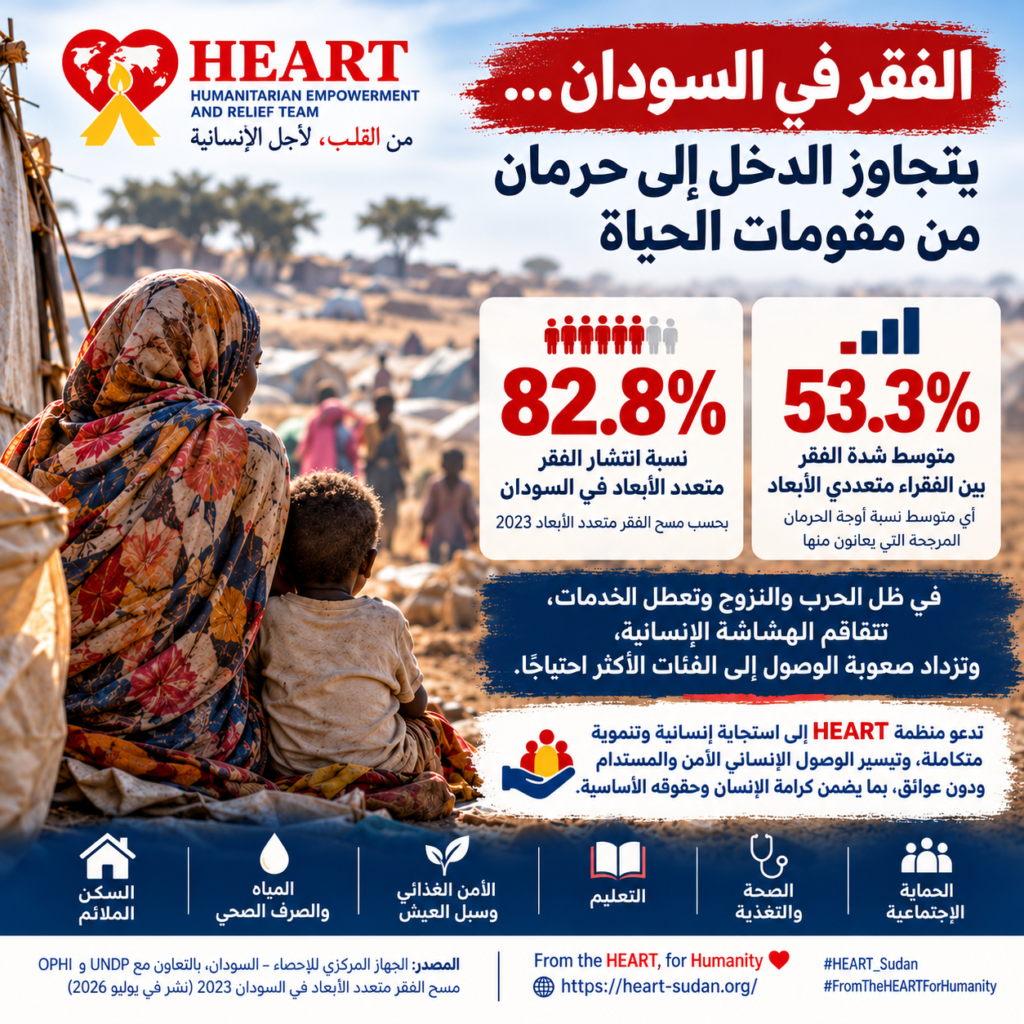
The Humanitarian Empowerment and Relief Team (HEART) highlights the alarming findings of Sudan’s Multidimensional Poverty Survey 2023, released in July 2026 by the Central Bureau of Statistics (CBS), in collaboration with the United Nations Development Programme (UNDP) and the Oxford Poverty and Human Development Initiative (OPHI).
The findings reveal the scale of deprivation affecting Sudanese communities and underscore the urgent need for coordinated humanitarian assistance, early recovery interventions, and sustainable development efforts.
📊 Key Findings: Poverty Beyond Income
According to the survey:
🔴 82.8% – Multidimensional Poverty Incidence: Approximately eight out of every ten people in Sudan experience overlapping forms of deprivation.
🔴 53.3% – Average Poverty Intensity: People identified as multidimensionally poor experience, on average, 53.3% of the weighted deprivations measured by the index.
🔴 0.441 – National Multidimensional Poverty Index (MPI): A measure reflecting both the prevalence and intensity of multidimensional poverty.
These findings demonstrate that poverty extends far beyond insufficient income. It encompasses interconnected disadvantages affecting access to healthcare, education, essential services, adequate living conditions, and opportunities for sustainable livelihoods.
Importantly, these figures are based on the 2023 survey and should not be interpreted as an updated assessment of the full humanitarian and socioeconomic consequences of the conflict through 2026.
⚠️ Armed Conflict Compounds Poverty and Humanitarian Vulnerability
Sudan’s ongoing armed conflict has further intensified an already challenging humanitarian situation.
Widespread displacement, loss of livelihoods, damage to essential infrastructure, disruption of agricultural production, and the deterioration of basic public services have increased the vulnerability of communities across the country.
For many Sudanese families, the consequences extend beyond the immediate loss of income and assets. They include growing difficulties in accessing food, safe drinking water, healthcare, education, and adequate shelter.
At the same time, the conflict has complicated humanitarian response operations.
Ongoing hostilities, insecurity along transportation routes, damaged infrastructure, administrative constraints, logistical challenges, and funding shortages continue to affect the ability of humanitarian organizations to reach vulnerable populations safely, consistently, and effectively.
Consequently, affected communities face two interconnected challenges: increasing humanitarian needs and persistent difficulties in accessing essential assistance and services.
Addressing these challenges requires sustained humanitarian engagement, improved operational access, and coordinated efforts to strengthen community resilience.
❤️ HEART’s Humanitarian Perspective
The Humanitarian Empowerment and Relief Team (HEART) emphasizes that addressing multidimensional poverty in Sudan requires an integrated approach that goes beyond immediate humanitarian relief.
While emergency assistance remains essential for saving lives, sustainable recovery also depends on restoring basic services, protecting livelihoods, and strengthening the ability of communities to rebuild their futures.
HEART calls for coordinated action across the following priorities:
🌾 Food Security and Livelihoods: Strengthening food assistance, supporting local agricultural production, and helping conflict-affected households restore sustainable sources of income.
🏥 Health and Nutrition: Improving equitable access to essential healthcare, nutrition services, and community-based health interventions.
📚 Education: Supporting access to education and protecting children from prolonged learning disruptions and educational exclusion.
💧 Water, Sanitation and Hygiene (WASH): Expanding access to safe drinking water, adequate sanitation facilities, and essential hygiene services.
🤝 Protection and Social Inclusion: Strengthening protection mechanisms and supporting women, children, young people, persons with disabilities, and other vulnerable groups.
🏘️ Early Recovery and Community Resilience: Supporting the rehabilitation of essential infrastructure and helping displaced and conflict-affected communities restore stability and basic services.
🕊️ Humanitarian Access and Civilian Protection: Promoting safe, sustained, and unhindered humanitarian access while advocating for the protection of civilians and humanitarian personnel.
🕊️ Commitment to Humanitarian Principles
HEART reaffirms its commitment to the four fundamental humanitarian principles:
Humanitarian assistance must be guided by assessed needs and delivered without discrimination, regardless of political affiliation, geographical location, or other considerations unrelated to humanitarian vulnerability.
The organization emphasizes that protecting civilians, facilitating humanitarian access, and ensuring assistance reaches those most in need are essential responsibilities in any humanitarian response.
Humanitarian neutrality does not mean remaining silent about human suffering. It means responding to that suffering impartially, independently, and without taking sides in hostilities or political controversies.
🌍 Beyond Emergency Relief: A Path Towards Recovery
Multidimensional poverty is more than a statistical indicator.
It represents children whose education has been interrupted, families struggling to secure sufficient food, patients unable to access essential healthcare, and communities deprived of the services and opportunities necessary for a dignified life.
In Sudan, the combined challenges of poverty, armed conflict, displacement, and restricted humanitarian access demand a response that connects immediate lifesaving assistance with longer-term recovery and development.
Sudan needs more than emergency relief. It needs sustained efforts to protect human dignity, restore essential services, rebuild livelihoods, and create the conditions for inclusive and sustainable recovery.
HEART remains committed to promoting evidence-based humanitarian action, community resilience, and people-centered approaches that place human dignity and humanitarian needs at the heart of the response.
📚 Data Source and Methodological Note
Source: Central Bureau of Statistics (Sudan), in collaboration with the United Nations Development Programme (UNDP) and the Oxford Poverty and Human Development Initiative (OPHI).
Report:Multidimensional Poverty Survey 2023 – Sudan Report Publication: July 2026
Methodological clarification: The reported multidimensional poverty incidence of 82.8%, average poverty intensity of 53.3%, and MPI value of 0.441 refer to the survey’s 2023 reference period. They do not constitute a current measurement of poverty levels in October 2026 or quantify the additional impact of the ongoing conflict.
Principles that define our integrity and guide our decisions
HEART’s Safeguarding Policy
HEART is committed to protecting all beneficiaries, staff, and partners from any form of abuse, exploitation, or neglect. Safeguarding is a shared responsibility and is integrated into all programs and activities from design to implementation. The policy ensures safe, confidential reporting mechanisms and timely, appropriate responses to safeguarding concerns. It promotes a culture of prevention, accountability, and duty of care, upholding dignity and human rights for all.
Policies
HEART’s Code of Conduct Policy
HEART sets clear standards of ethical and professional behavior for all staff and partners. The policy promotes integrity, respect, and accountability in all actions and decisions. It defines acceptable conduct and prevents misconduct, abuse of power, and conflicts of interest. Compliance with the Code ensures trust, responsibility, and organizational credibility.
Policies
HEART’s Anti-Corruption & Anti-Fraud Policy
HEART maintains zero tolerance for corruption, fraud, bribery, and misuse of resources. The policy promotes transparency, integrity, and responsible management of funds and assets. It establishes clear controls, reporting mechanisms, and consequences for violations. Compliance safeguards donor trust, organizational credibility, and humanitarian impact.
Policies
HEART’s Humanitarian Protection Policy
HEART is committed to protecting affected populations from violence, abuse, and rights violations. The policy integrates protection principles across all programs and operational decisions. It prioritizes safety, dignity, and meaningful access to assistance. Protection actions are guided by accountability, inclusion, and do-no-harm principles.
Policies
HEART’s Emergency and Disaster Response Policy
HEART provides timely, coordinated, and needs-based responses to emergencies and disasters. The policy guides preparedness, rapid response, and early recovery actions. It ensures flexibility, coordination, and efficient use of resources during crises. All responses prioritize lifesaving assistance, dignity, and accountability.
Policies
HEART’s Partnerships and Coordination Policy
HEART values partnerships as a key approach to maximize humanitarian impact and effectiveness. The policy promotes principled coordination with local, national, and international actors. It ensures clear roles, shared accountability, and alignment with humanitarian standards. Effective partnerships strengthen access, efficiency, and community-centered responses.